

Autumn Statement 2023

On 22 November 2023, Chancellor Jeremy Hunt presented his Autumn Statement to Parliament.
In it, he started making, in his words, the long-term decisions necessary to strengthen the economy and build a brighter future. Fueled by falling inflation and stabilised public finances, focus is now being applied to reducing debt, cutting tax and rewarding hard work.
Headlines included generous National Insurance Contribution (NIC) cuts for workers and the self-employed and the ‘biggest permanent tax cut in modern British history for businesses’. Some other anticipated measures appear to be on hold ahead of a full Budget next Spring and an expected 2024 general election.
Below, we talk more about the Autumn Statement headlines and other measures announced. Please note that ‘tax years’ run to 5 April each year and that, for example, 2024/25 signifies the year to 5 April 2025.
CUTTING TAX AND REWARDING HARD WORK
-
In addition to income tax, all employees earning more than £12,570 a year pay Class 1 NICs. The main rate of Class 1 NICs will be cut from 12% to 10% from 6 January 2024. This will come into effect from January 2024 and, over a full year, the average worker on £35,400 will receive a NIC reduction of over £450. Workers earning more than £50,270 a year will receive a NIC reduction of £754.
The Class 1 NIC rate will remain at 2% for earnings above £50,270 a year.
Similarly, there are no changes to the rate of employer’s Class 1 NICs, which remains at 13.8%.
-
Self-employed individuals with profits of more than £12,570 a year pay two types of NIC: Class 2 and Class 4.
Class 2 NICs have been at a flat rate sum of £179.40 a year (£3.45 a week) in 2023/24 but no one will be required to pay the charge from 6 April 2024.
The main rate of Class 4 NICs will be cut from 9% to 8% from 6 April 2024. Class 4 NICs will continue to be calculated at 2% on profits over £50,270.
Taken together these changes will result in an average self-employed person with profits of £28,200 saving £336 in 2024/25.
Class 2 NICs currently provide the self-employed with access to a range of state benefits, including the State Pension. From 6 April 2024, self-employed people with annual profits;
Above £12,570 – will continue to receive access to the benefits.
Between £6,725 and £12,570 - will continue to receive access to the benefits, via a National Insurance credit.
Under £6,725 (or with losses) – will be able to continue to pay Class 2 NICs on a voluntary basis in order to maintain their access to state benefits. Class 2 NICs had been due to increase in 2024/25 but it seems that these will be maintained at the current £3.45 weekly level for those in this bracket.
State Benefits
The government will uprate all working age benefits for 2024/25 by the September 2023 Consumer Price Index (CPI) of 6.7% and will continue to protect pensioner incomes by maintaining the promised ‘triple lock’ and uprating the basic State Pension, new State Pension and Pension Credit standard minimum guarantee for 2024/25 in line with highest of the three possible measures, namely average earnings growth of 8.5%.
National Minimum Wage (NMW)
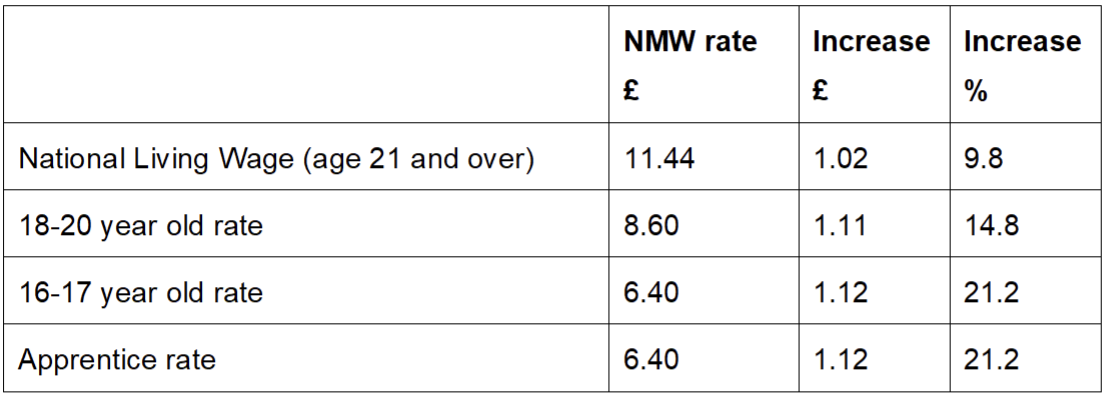
The biggest ever increase to the National Living Wage has been announced, with the government fully accepting the recommendations made by the Low Pay Commission. Eligibility for the National Living Wage will also be extended by reducing the age threshold to 21-year-olds for the first time. It was previously for those aged 23 and over only. From 1 April 2024 the minimum pay rates will be as follows:
Backing British Business
-
The Annual Investment Allowance (AIA) is now permanently set at £1million. This means that businesses can claim tax relief at 100% on up to £1million of expenditure on qualifying plant and machinery (e.g. capital equipment).
The Annual Investment Allowance (AIA) is now permanently set at £1million. This means that businesses can claim tax relief at 100% on up to £1million of expenditure on qualifying plant and machinery (e.g. capital equipment).
‘Full expensing’ is an additional and alternative relief for companies only. It allows unlimited 100% upfront tax relief on qualifying plant and machinery that is purchased in a new condition on or after 1 April 2023. There is also an associated 50% allowance for expenditure on certain types of plant and machinery that does not qualify for the full 100% (including space and water heating systems, for example).
This ‘full expensing’ regime was initially introduced in Spring 2023 and had an original end date of 31 March 2026. It has now been announced that it will be made permanently available. Described as the ‘biggest business tax cut in modern British history’ it must be noted that it will usually only benefit companies or groups of companies that have already utilised their £1million AIA. It is not available at all for unincorporated businesses, although the expansion of the cash-basis (see below) achieves a very similar effect for sole traders and partnerships.
Full expensing does come with some quite complicated rules on the amount of upfront relief and the calculation of tax charges that may apply when the purchased plant and machinery is sold. Please talk to us for more details.
-
Under MTD for income tax, businesses will keep digital records and send a quarterly summary of their business income and expenses to HMRC using MTD-compatible software. These requirements will be phased in from April 2026, starting with sole traders and property landlords with gross income over £50,000.
In readiness, some ‘design changes’ to the scheme have now been announced to simplify and improve the system. These include:
Simplifying the requirements for providing quarterly updates by making them cumulative and adding functionality to amend or correct errors throughout the year;
Simplifying the rules for taxpayers with more complex affairs, such as landlords with jointly-owned property;
Removing the requirement to provide an End of Period Statement, with emphasis instead placed on a final declaration;
Exempting some taxpayers altogether, including foster carers and those without a National Insurance number; and
Enabling taxpayers using MTD to be represented by more than one tax agent.
There will also be new rules to ensure that taxpayers who volunteer to join MTD for income tax from April 2024 will be subject to the new, fairer points-based penalty regime for late filing of tax returns and late payment of tax, as already implemented for VAT. This approach assures the compliant majority that an occasional failure in the context of overall good compliance will not be treated in the same way as persistent poor compliance.
-
A new business rates support package worth £4.3 billion will be made available over the next five years to support small businesses and the high street. For 2024/25, the small business multiplier will continue to be frozen and the 75% Retail, Hospitality and Leisure business rates relief will continue to apply.
The standard rate multiplier will be uprated in line with the September 2023 CPI of 6.7%. While this will increase business rates bills for some, large retailers are expected to benefit from hundreds of millions of pounds of tax relief per year as a result of full expensing.
-
One of the key challenges facing small businesses is the cash-flow implications of late payments, which hold them back from investing and innovating. The government plans to lead by example by introducing more stringent payment time requirements for firms bidding for large government contracts. From April 2024, firms bidding for government contracts over £5million will have to demonstrate that they pay their own invoices within an average of 55 days, tightening to 45 days in April 2025, and to 30 days in the coming years.
-
Various initiatives are on the cards for business leaders to acquire the vital skills and opportunities they need to stay relevant, increase productivity and grow their businesses.
This includes a pledge that HMRC will rewrite its guidance on the tax deductibility of training costs for sole traders and the self-employed, to provide more clarity to business on what costs are deductible. This will ensure that individuals can be confident that updating existing skills, or maintaining pace with technological advances or changes in industry practices, are allowable costs for tax purposes.
-
Unincorporated businesses that prepare annual accounts to a year-end date other than 31 March or 5 April will soon need to either change their accounting year-end or adopt a new process for how the profits or losses arising in their accounts are reported to HMRC.
At present, ‘basis period’ rules apply that broadly allow annual accounts that end during a tax year to act as the basis of profits or losses arising in that tax year.
A new system starts with transitional rules in 2023/24. From 2024/25, actual profits (or losses) arising in a tax year must be reported to HMRC by calculating and combining appropriate proportions of tax-adjusted profits (or losses) for the parts of each accounting period that overlap with a tax year.
Unfortunately, this will make it harder for some self-employed individuals to fulfil their tax compliance obligations and predict their income tax liabilities, but we will be on hand to help you.
-
The ‘cash basis’ can be a simplified way of calculating taxable profits for income tax purposes. It is based on simply declaring income received and expenses paid, without adjustments seen in more sophisticated accounts prepared in accordance with traditional ‘accruals based’ principles (e.g. to include adjustments for stock valuations and amounts owed by customers). The cash basis is currently an option for sole traders and partnerships if their annual business turnover is £150,000 or less.
In a significant shift from 6 April 2024, the cash basis will become the default accounting basis for all unincorporated businesses. The £150,000 turnover limit will be removed and some of the restrictions within the current regime that limit relief for interest deductions and loss relief will also be removed.
Businesses can ‘opt out’ of the cash basis and continue to prepare a balance sheet and use the ‘accruals basis’ if they wish. This will be an important choice, particularly in relation to business intelligence and management reporting, so please do talk to us about the options if this affects you.
-
Earlier this year, the government announced that it would establish 12 ‘Investment Zones’ across the UK. These Zones target tax and other incentives on high potential industry sectors to boost productivity and growth. A number of the Zones have now been announced and the Chancellor has now pledged to extend the program of funding and tax reliefs for these Zones from 5 to 10 years.
The tax incentives include relief from Stamp Duty Land Tax (SDLT), enhanced capital allowances for plant and machinery, enhanced structures and buildings allowances, business rates relief and reduced employer NICs on the earnings of eligible employees.
There has also been an associated extension to the window to claim Freeport tax reliefs in England; from 5 to 10 years, until September 2031. The tax benefits on offer in these port-based locations are similar to Investment Zones but also give extra VAT and Customs benefits.
VAT
The VAT registration and deregistration thresholds continue to be frozen at £85,000 and £83,000 respectively, instead of increasing each year in line with inflation. This is thought to be a blocker to growth in small businesses and so will be one to watch in the Spring Budget next year.
There have been no change to rates of VAT.
Income Tax
‘Stealth’ increases
The personal allowance and basic rate band threshold are still frozen at their 2021/22 levels and, subject to the outcome of the next general election, are expected to remain at such until 5 April 2028. As earnings increase, individuals will move into higher tax bands. This is often referred to as ‘fiscal drag’ because it will raise more tax without the government increasing income tax rates.
The tax-free personal allowance of £12,570 continues to be partially and then fully withdrawn for higher earners, with £1 of personal allowance lost for every £2 of adjusted net income over £100,000.
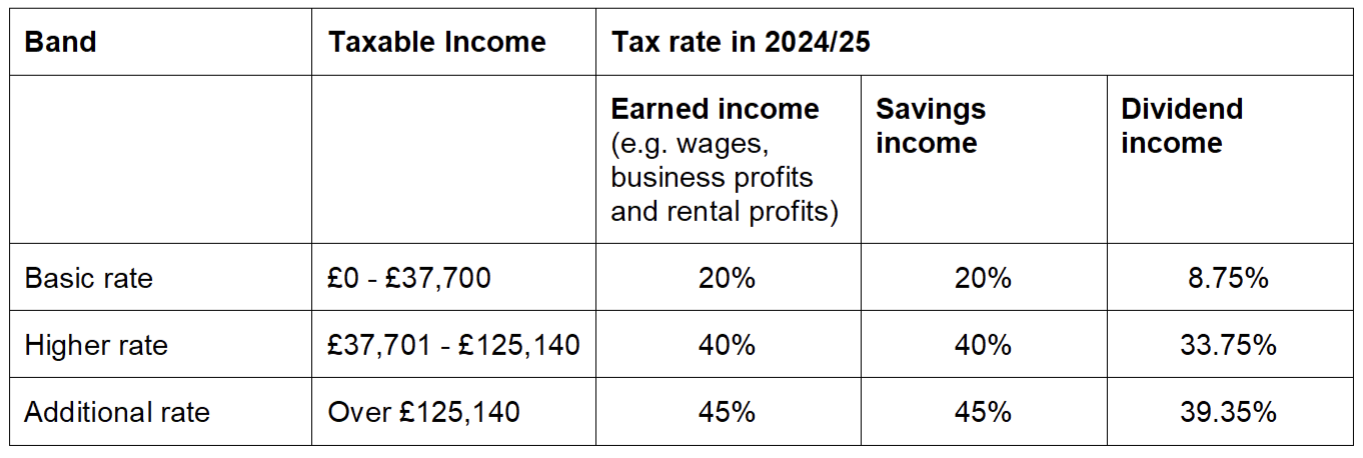
Income tax rates and allowances for 2024/25
Held at their 2023/24 levels, the following income tax rates will apply to taxable income, after the personal allowance has been utilised.
Other allowances
Savings income continues to benefit from a 0% personal savings allowance of £1,000 for basic rate taxpayers and £500 for higher rate taxpayers.
Dividend income attracts a 0% dividend allowance of £500 in 2024/25, down from the £1,000 allowance seen in 2023/24.
Scotland
Individuals living in Scotland and classed as Scottish taxpayers are also entitled to the personal allowance of up to £12,570 but have a slightly different banding system for ‘earned income’ as follows:
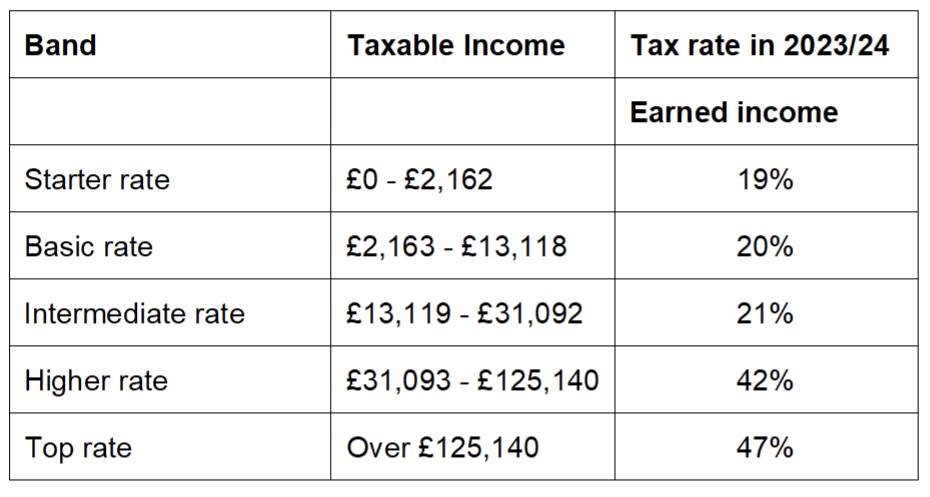
The application of income tax to savings and dividends income is the same as for taxpayers based elsewhere in the UK.
The Scottish Budget, in which rates and bands for 2024/25 are expected to be announced, is set to take place on 19 December 2023.
-
The annual limits for Individual Savings Accounts (ISAs), Child Trust Funds and the Junior ISA remain at £20,000, £9,000 and £9,000 respectively in 2024/25. The lifetime ISA annual subscription limit also remains unchanged at £4,000 (excluding the government top-up bonus).
The government is making changes to simplify ISAs and provide more choice, meaning it will be easier to choose the best ISA accounts and move money between them. This involves digitalising the ISA reporting system to make it more effective, as well as expanding the investment opportunities available in ISAs.
-
Annual allowances determine the maximum amount that an individual can save into their pension pots in a tax year before tax relief starts to be withdrawn by way of pension tax charges.
These allowances will remain fixed in 2024/25 at their 2023/24 rates, being the £60,000 annual allowance applicable in most circumstances and the £10,000 money purchase annual allowance for those who have flexibly accessed their pension pot. The annual allowance is reduced for those with a high income of more than £260,000.
Pension Reform
The government has announced a comprehensive package of pension reforms that aim to provide better outcomes for savers, drive a more consolidated pensions market and enable pension funds to invest in a diverse portfolio.
With people (especially younger generations) changing jobs more frequently than used to be the case, the government wants to tackle the long-standing problem of “small pot” pensions that accumulate with each short to medium term employment. There will be a call for evidence on a ‘lifetime provider model’ which would allow individuals to have contributions paid into their existing pension scheme when they change employer, providing greater agency and control over their pension.
Capital Gains Tax
The capital gains tax annual exemption is set to drop to £3,000 in 2024/25, down from £6,000 in 2023/24. This change will mean that those selling capital assets such as property or shares will pay more tax, where the new lower annual exemption is exceeded. Capital gains tax rates range from 10% to 28% in 2023/24, depending on the tax status of the seller and the type of asset sold.
If you are planning any capital disposals, please contact us to discuss the best strategy for the disposal.
Inheritance Tax
The inheritance tax nil rate band continues to be frozen at £325,000 until April 2028. The residence nil rate band will also remain at £175,000 and the residence nil rate band taper will continue to start at £2million. Despite prior rumours to the contrary, there has been no change to inheritance tax rates.
Corporate Taxes
-
From 1 April 2024, the rate of Corporation Tax will continue to be 25% if a company’s profits exceed £250,000 a year. The small profits rate of 19% will apply where profits are no more than £50,000 a year.
Where a company’s profits fall between £50,000 and £250,000 a year, the profits are taxed at the higher 25% rate, but a ‘marginal relief’ is given to reduce the liability, with the effective rate being closer to 19% the closer profits are to £50,000.
Companies in the same corporate group (or otherwise connected by association) must share the £50,000 and £250,000 thresholds between them, making the 25% rate more likely to apply. A similar rule applies to the £1.5million threshold which, if exceeded, means that companies are required to pay their corporation tax earlier and in instalments.
-
For company accounting periods commencing on or after 1 April 2024, a new R&D scheme for limited companies will come into effect, merging the current R&D Expenditure Credit (RDEC) scheme (for larger companies) with the Small and Medium Enterprise (SME) scheme. There will also be a second new R&D scheme for ‘R&D intensive SMEs’.
These are significant changes and come on top of a raft of changes already seen in 2023. HMRC say that further action may still be needed to reduce the unacceptably high levels of non-compliance with tax rules in the R&D sector.
Within the new rules there are new provisions in relation to:
Who can claim relief when companies contract out R&D activities;
The definition of qualifying expenditure, taking into account whether the R&D has been undertaken in the UK,
The qualifying criteria for ‘R&D intensive’ companies, along with a new approach for companies who many fluctuate in and out of the status; and
Restrictions on nominations and assignments of R&D relief payments.
Any company claiming (or considering claiming) R&D reliefs will need enhanced support to both ensure compliance and to adopt the new rules and framework. Please do get in touch if we can assist you with this.
-
Film, TV and video games tax reliefs will be reformed into refundable expenditure credits. In particular, an Audio-Visual Expenditure Credit (AVEC) for film and TV programmes and a Video Games Expenditure Credit (VGEC) for video games. The credits will be available from 1 January 2024.
-
The ATED annual charges will rise by 6.7% from 1 April 2024 in line with the September 2023 CPI.
Employment Taxes
-
Like the main income tax bandings, employer and employee NIC thresholds are now also frozen until 5 April 2028. This broadly means that, in 2024/25, employers’ NIC will continue to apply at 13.8% to earnings in excess of £9,100 a year (£175 per week) and employees will pay at the reduced 10% rate on earnings between £12,570 and £50,270 and 2% thereafter.
For eligible employers, the employment allowance remains at £5,000 per year, reducing their employer’s NIC liability by this sum. Eligible employers should remember to opt in on their payroll software to ensure that the allowance is received.
-
Employees are required to pay income tax on certain non-cash benefits. For example, the provision of a company car constitutes a taxable ‘benefit in kind’. Employers also pay Class 1A NIC at 13.8% on the value of benefits.
The set percentages used to calculate company car benefits are fixed until 5 April 2026 before slight increases apply to most car types, including electronic and ultra-low emission, from 6 April 2026.
The figures used to calculate benefits-in-kind on employer-provided vans, van fuel (for private journeys in company vans), and car fuel (for private journeys in company cars) remain fixed at their 2023/24 levels in 2024/25. These are:
Van benefit £3,960
Van fuel benefit £757
Car fuel benefit multiplier £27,800
-
For individuals with income taxed only through PAYE, they currently only need to file a self-assessment tax return if their income exceeds £150,000. From 2024/25 this threshold will be removed altogether, removing up to 338,000 individuals from the self-assessment system.
-
Off-payroll working rules ensure that a worker who provides services through an intermediary company to a ‘deemed employer’ pays broadly the same income tax and NIC as an employee would. The rules are complicated and apply differently depending on the size and type of the deemed employing entity.
The new rules deal with cases where HMRC is collecting underpaid PAYE from the deemed employer and will allow them to give credit for any tax and NIC already paid by the worker and their intermediary. This is to avoid the potential over-collection of tax.
Tackling the Tax Gap and Collecting HMRC Debt
The government continues to commit to a tax system that is easy for businesses and individuals to engage with, and where everyone pays their fair share.
A ‘Tackling the Tax Gap’ package of measures has been announced, with plans to raise £5 billion of tax revenue over the next five years. The government is investing in HMRC’s ability to better target their debt
collection activity, pursuing those with tax debts that can afford to pay, and providing support to those that are temporarily unable to pay. The government is also taking action against those who continue to bend or break the rules, by reducing opportunities for tax fraud in the construction industry and taking strong action against promoters of tax avoidance. Sentences for the most egregious forms of tax fraud will be doubled from 7 to 14 years.
Tax Administration Framework
New measures will be introduced to strengthen HMRC’s data gathering powers. From 2025/26:
Employers will be required to provide data on employee hours paid as part of their PAYE reporting; and
Shareholders in owner-managed businesses will be required to include on their self-assessment tax return their percentage shareholding and dividend income from their company (separately to any other dividend income they may receive).
These measures will build on previously announced HMRC powers that will enable them to access taxpayer data from online marketplaces (e.g. from airbnb) from 1 January 2024.
In Conclusion
As we move into 2024, there are a lot of tax changes already scheduled, plus we can expect more with a Spring Budget and a general election on the horizon.
We are here to work alongside you and help you prosper so please do get in touch at any time.
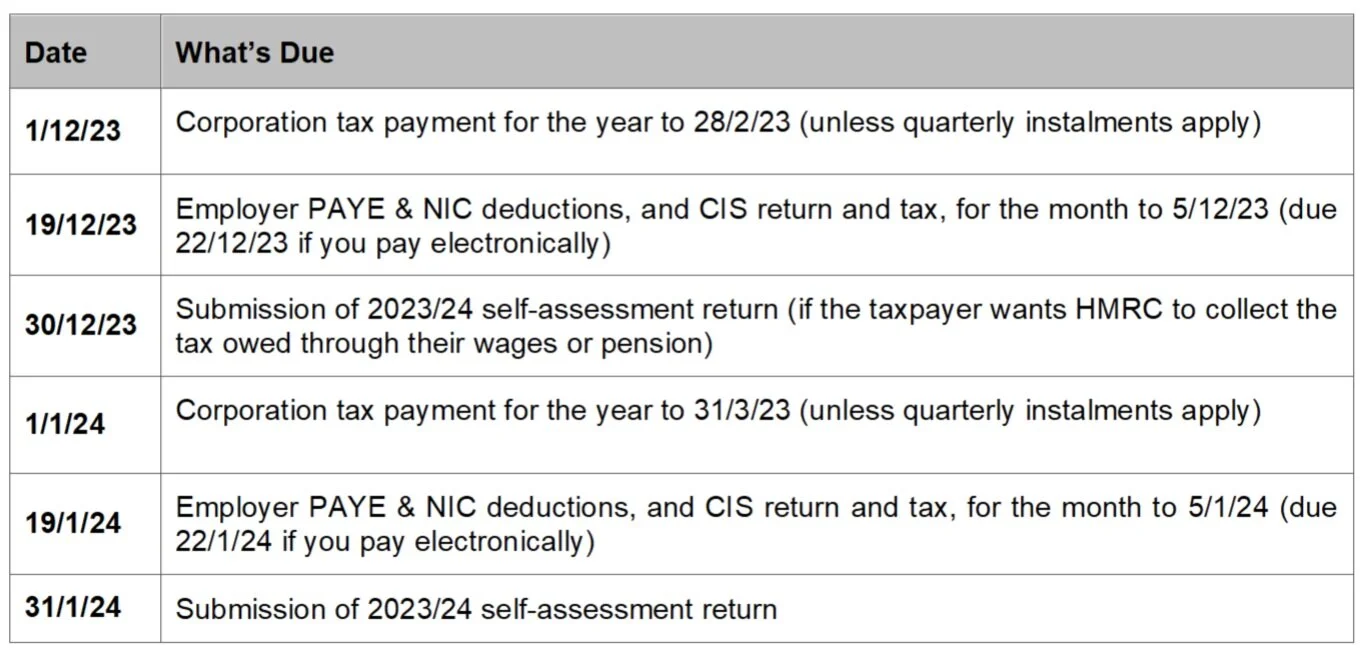
Diary of Main Tax Events
December 2023 / January 2024

Looking for a quick and easy way to tick your business accounts off your to-do list?
Our free download will provide you with an overview of the key accounting concepts and tools you'll need to manage your business finances effectively.
To get yours, simply fill out the form below.